The Ten Commandments
Ten words spoken in fire on Sinai, the shape that love takes when it has been received.

The Ten Commandments, the Decalogue, are the ten words that God spoke to Moses on the summit of Mount Sinai in fire and thunder, and wrote with His own finger on two tablets of stone. They are the founding charter of the moral life of the human race, the covenant by which the Lord claimed Israel as His own people, and the eternal law that the Lord Jesus came not to abolish but to fulfill. "If you love Me," He said, "keep My commandments", and then in the Sermon on the Mount He deepened each of them, teaching that the Law reaches not only to outward actions but to the hidden thoughts and desires of the heart.
The first three commandments order us toward God: to worship Him alone, to reverence His holy Name, and to keep His day holy. The remaining seven order us toward our neighbor: to honor our parents, to refuse to kill, to keep the body pure, not to steal, not to bear false witness, and not to covet anything that belongs to another. Saint Augustine called them "the ten strings of the psaltery of God", each string sounding its own note, and all of them together making the music of a holy life. Saint Thomas Aquinas spent a hundred pages of the Summa on the Decalogue, showing how every act of charity and every virtue of the Christian life flows from its precepts.
The Decalogue is not a mere code of rules but a word of love. Each commandment is a fence raised around a treasure, the treasure of God Himself, the treasure of human dignity, the treasure of marriage and family, the treasure of property and reputation, the treasure of a heart at peace. "The commandments," writes the Catechism, "properly so-called come in the second place: they express the implications of belonging to God." They are not the price of God's love. They are the shape that love takes when it has been received.
Every Catholic child learns the Ten Commandments in preparation for First Confession, and every Catholic adult returns to them in the examination of conscience before the sacrament of Penance. They are carved above the doors of courthouses and written in the hearts of the faithful. The Church has never assigned them a fixed feast day, they belong to every day, every hour, every breath of the Christian life, but they are honored here as the foundation of all catechesis, of the moral life, of every preparation for Confession, and of the whole covenant of the Old and New Testaments.
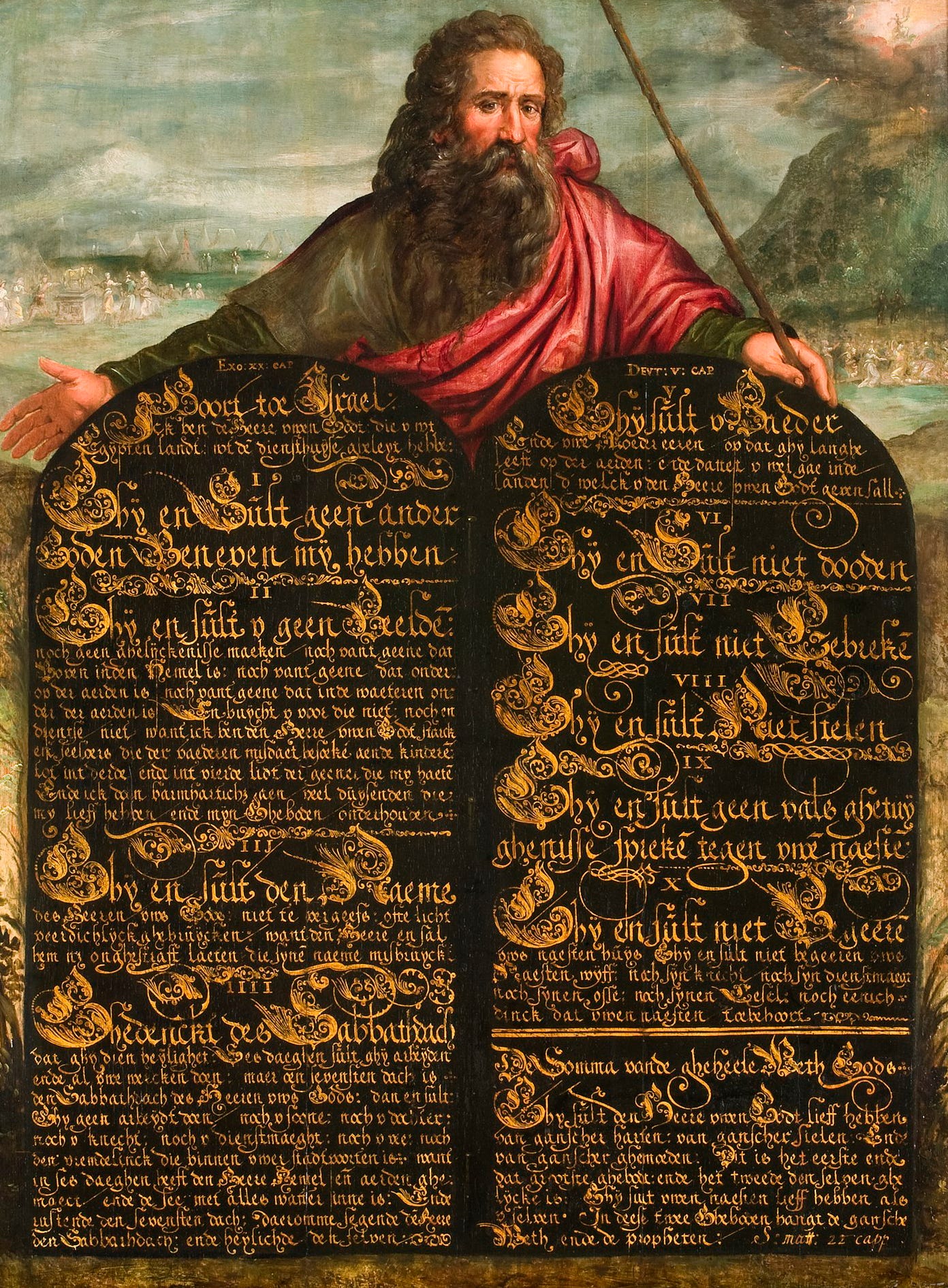
The Ten Commandments — Museum Catharijneconvent. Public Domain.
"I am the LORD your God, who brought you out of the land of Egypt, out of the house of slavery. You shall not have other gods beside me." — Exodus 20:2–3
Act of Contrition
O my God, I am heartily sorry for having offended Thee, and I detest all my sins because of Thy just punishments, but most of all because they offend Thee, my God, who art all good and deserving of all my love. I firmly resolve, with the help of Thy grace, to sin no more and to avoid the near occasion of sin. Amen.
Standard form taught in the Baltimore Catechism, traditional in Roman Catholic practice
Further Reading and Reflection
- The Ten Commandments (Exodus 20): USCCB - The Catechism of the Catholic Church on the Ten Commandments (Vatican) - Ten Commandments: Britannica